K-Points News: Beyond the Headlines — War, Unrest, Commodity Prices, and Beyond

K-Points News: Beyond the Headlines — War, Unrest, Commodity Prices, and Beyond
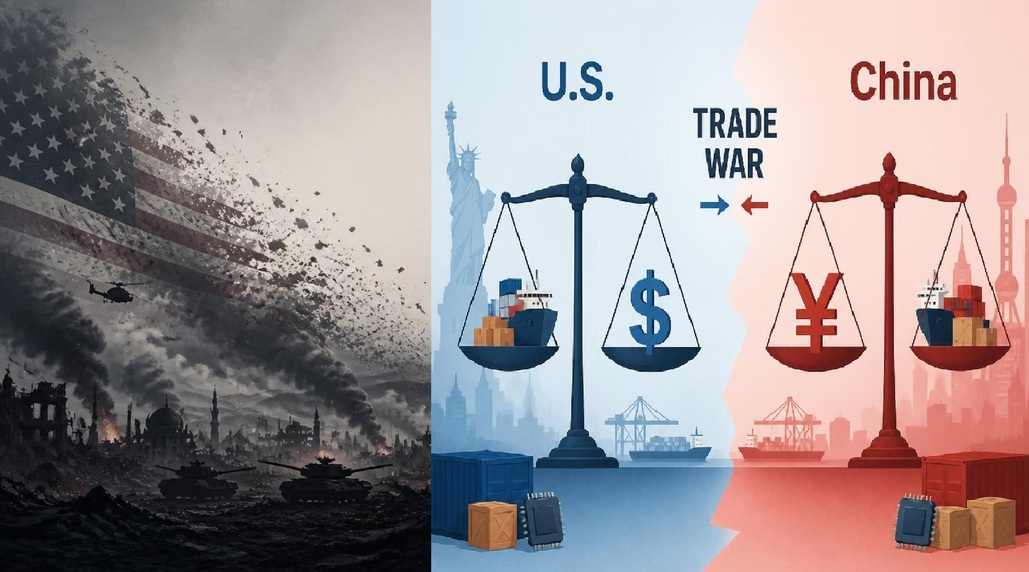
As U.S. Loses Ground in Iran War, It Ramps Up Economic War with China
After five months of open conflict with Iran, the United States has failed to achieve a single one of its strategic objectives and has effectively lost the war—a defeat that many analysts are calling the worst in American military history. The conflict, which began with high hopes for a swift and decisive outcome, has instead exposed deep vulnerabilities in U.S. military strategy and power projection in the Middle East.
In the most recent escalation, a 13-day sustained bombing campaign by U.S. forces against Iranian military positions failed to significantly improve Washington's strategic position. Instead of crippling Iran's military capabilities, the strikes provoked a robust and well-coordinated retaliatory response from Tehran. Iranian missiles and drone attacks struck numerous U.S. military bases across the region, inflicting heavy casualties, damaging critical infrastructure, and destroying billions of dollars' worth of equipment.
Faced with mounting losses, and no clear path to victory, the United States is once again turning to diplomacy. According to officials from both Qatar and the United States, backchannel talks are currently underway between Washington and Tehran aimed at reopening the strategically vital Strait of Hormuz, through which a significant portion of the world's oil supply transits. However, the Iranian government has so far neither confirmed nor denied the existence of these talks, maintaining a cautious silence.
In a statement, U.S. President Donald Trump declared that this represents Iran's "last chance" to reach an agreement "before decapitation"—a threat widely interpreted as referring to regime change or decapitation strikes against Iranian leadership. Iran responded with restraint, stating that it is "not seeking to expand the war," while making clear that it retains full military readiness to defend its sovereignty.
On a separate but equally significant front, the United States is escalating its economic war against China. The U.S. Department of Homeland Security (DHS) has added 43 more Chinese companies to the so-called "Uyghur Forced Labor Prevention Act (UFLPA) Entity List," expanding the total number of blacklisted entities to 187. This represents the largest single expansion since the list was established. For the first time, the sanctions are targeting well-known Chinese consumer brands in the food and apparel sectors—companies like Chacha Food (a popular snack brand), Zhengzhou Synear Food (a frozen food giant), and Septwolves (a major clothing retailer). According to the Global Times, these additions mark a significant broadening of the supply chain crackdown.
“Washington’s inclusion of Chinese food and clothing companies on its sanctions list reflects the widening scope of its efforts to contain China,” said Xin Qiang, deputy director of the Center for American Studies at Fudan University. He added that such measures, “driven not by facts but by speculation and political bias, are increasingly turning normal trade into a target of politicization.”
