K-Points: Beyond the Headlines — War, Unrest, Commodity Prices, and Beyond
K-Points: Beyond the Headlines — War, Unrest, Commodity Prices, and Beyond
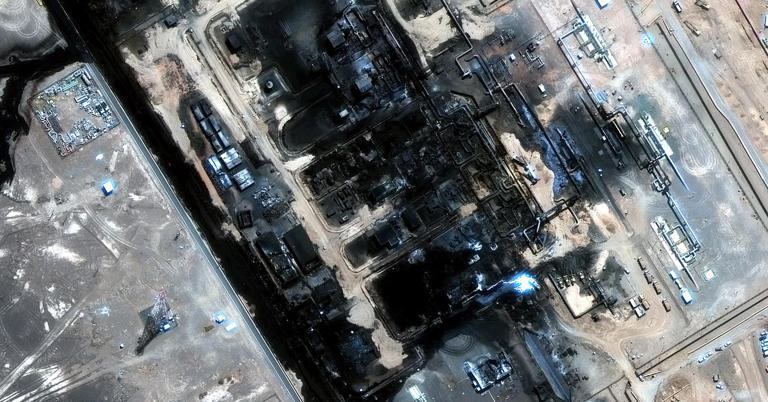
Satellite image of fire-damaged structures of the East-West pipeline pumping station in Saudi Arabia (Photo by: Satellite image Vantor/AFP)
Brent Crude Soars to $108 Amid Extensive Damage to Saudi Pipelines and Ongoing Blockades of the Strait of Hormuz and Bab el-Mandeb
Global oil prices surged on Monday, with Brent crude futures climbing past the $108 per barrel mark after satellite imagery revealed that damage to a key Saudi Arabian pipeline is more extensive than initially assessed, likely requiring weeks of repairs rather than. The revelation has intensified concerns over supply reliability in an already Middle East.
According to a report from The Associated Press, Saudi’s East-West Pipeline—a critical conduit for transporting crude the Kingdom’s eastern oil fields to the Red Sea—has taken offline. The pipeline was struck by a drone attack last, and the newly released satellite images indicate structural damage that will necessitate prolonged shutdown stretching into several weeks.
The timing of the outage is particularly acute. Saudi Arabia has increasingly relied on the East-West Pipeline as a strategic alternative route for crude exports away from the Strait of Hormuz, a narrow and strategically vital waterway through which roughly one-fifth of global oil consumption passes. As tensions between the United States and Iran continue to simmer, the pipeline has served as a crucial safety valve. With a total design capacity of 7 million barrels per day following recent expansions, its closure removes a significant volume of supply from the market at a moment of heightened geopolitical uncertainty.
Compounding the supply squeeze, Yemen’s Houthi forces—who have escalated both aerial attacks and ground offensives—have intensified their campaign against Saudi infrastructure. In addition to the pipeline strike, the Houthis have launched a lightning ground offensive aimed at exerting control over another critical oil artery: the Bab el-Mandeb Strait, located at the southern tip of the Arabian Peninsula. This chokepoint links the Red Sea to the Gulf of Aden and is a vital transit route for tankers carrying Middle Eastern crude to European and Asian markets.
The Houthis have declared that they will maintain a blockade of Saudi oil shipments through the Bab el-Mandeb for as long as Riyadh continues its own blockade on Yemen. This reciprocal standoff has effectively closed two of the world’s most important energy maritime routes—Hormuz and Bab el-Mandeb—while the Saudi pipeline shutdown removes a key alternative pathway fro Saudi oil export.
Even if the pipeline were fixed overnight, it wouldn’t offer any quick fix for global energy prices—not while the Strait of Hormuz stays shut, Houthis attacks on Red Sea oil shipments continues and , and Trump’s refusal to pursue diplomacy with Iran drags on with no resolution in sight.
These are the consequences of the United States’ attack on Iran. The operation not only ended in a decisive defeat for the United States, but also triggered a severe global energy crisis. The conflict disrupted oil production and exports, destabilized international markets, drove energy prices sharply higher, and created widespread economic uncertainty for countries around the world.