K-Points: Beyond the Headlines — War, Unrest, Commodity Prices, and Beyond
K-Points: Beyond the Headlines — War, Unrest, Commodity Prices, and Beyond
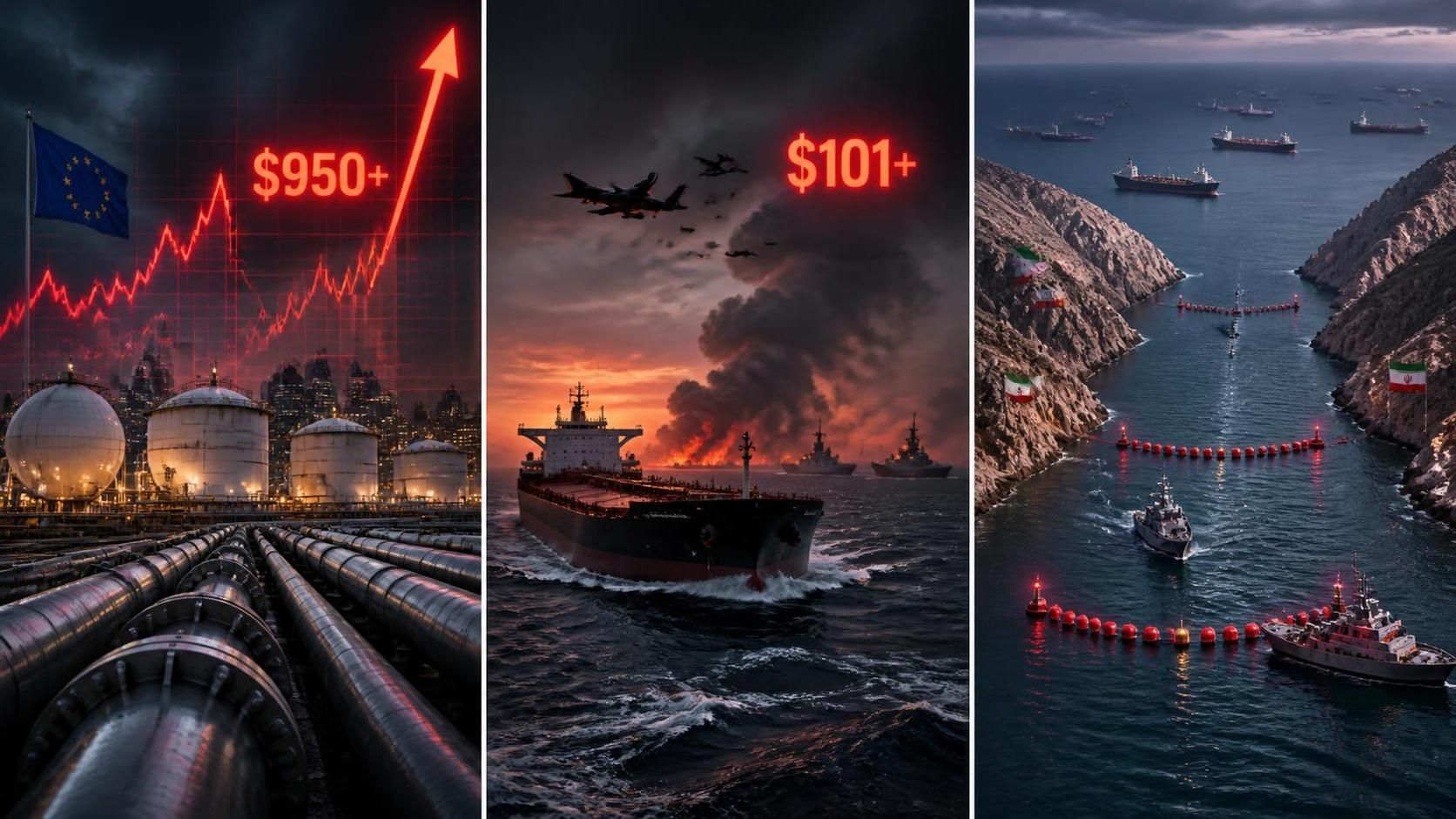
European Gas Prices Surge Past $950 Mark; Brent Crude Jumps Above $101 After U.S. Strikes Iranian Tankers and Iran Hits Back at American Assets; Iran to Ban Ships Entering Restricted Zone from Ever Crossing Strait of Hormuz (September 9)
European Gas Prices Surge Past $950 Mark
European natural gas prices surged past950 per 1,000 cubic meters on Wednesday for the first time since December 2022, according to data from the London-based ICE exchange. The October futures contract at the TTF hub in the Netherlands climbed to approximately 950.3
per 1,000 cubic meters, equivalent to €78.925 per megawatt-hour (MWh).
This sharp rise reflects mounting concerns over energy security as the continent heads into winter. Storage levels across Europe have fallen to record lows for this time of year, driven by a combination of factors: prolonged cold snaps early in the 2022–2023 winter, reduced Russian pipeline flows following the Ukraine war and European sanctions on Russia, and heightened demand for liquefied natural gas (LNG) amid global competition. The ongoing conflict in the Middle East has added a layer of geopolitical risk, threatening key supply routes and stoking fears of further disruptions. Analysts warn that without a rapid reversal in storage trends or a mild winter, prices could climb even higher, putting additional strain on households and industries already grappling with high energy costs.
Brent Crude Jumps Above $101 After U.S. Strikes Iranian Tankers and Iran Hits Back at American Assets
The price of Brent crude oil surged past the $101 per barrel mark in early trading following a significant escalation in hostilities between the United States and Iran. The overnight confrontation began when the American military announced it had "destroyed" five Iranian oil tankers in the Persian Gulf region. According to the Pentagon, the strikes were carried out in direct response to an attack by Iran’s Islamic Revolutionary Guard Corps (IRGC) on a US warship.
However, analysts warn that the US strategy of targeting Iranian tankers as retaliation for attacks on American naval assets faces a critical strategic flaw. Tehran may place far greater value on successfully damaging a US destroyer than it does on losing a cargo vessel, especially given that many of these tankers are believed to be empty or operating under sanctioned trade routes. In essence, the asymmetric calculus favors Iran: a single successful hit on a US warship carries immense symbolic and strategic weight, while the loss of a tanker—a floating asset already under heavy sanctions—may be viewed as an acceptable cost.
In a swift and heavy retaliatory response, Iran struck back across multiple fronts. Reports indicate that Iranian forces targeted US military bases in Jordan, as well as two US naval vessels, eight oil tankers, and ten additional ships in separate but coordinated attacks. On Wednesday, the IRGC issued an official statement detailing the scope and rationale of its operations.
“The heroic IRGC Navy, in response to the aggression and hostility of the terrorist US military in its attack on five Iranian oil tankers in the Persian Gulf, targeted two US vessels and eight oil tankers in the area, inflicting heavy damage on them,” the statement read.
The IRGC further claimed that ten additional ships were targeted after they attempted to traverse and unsafe zone within the Strait of Hormuz, allegedly with "provocation and support" from the United States. The statement concluded with a pointed declaration of control: “The Strait of Hormuz remains firmly under the surveillance and management of the capable and valiant IRGC Navy.”
Iran to Ban Ships Entering Restricted Zone from Ever Crossing Strait of Hormuz
Iran has announced a sweeping new maritime policy that will permanently bar any vessel entering its newly declared "maritime exclusion zone" from ever crossing the Strait of Hormuz, according to a statement from a senior commander of the Islamic Revolutionary Guard Corps (IRGC).
Hossein Mohebi, the spokesman for the IRGC—the elite branch of Iran’s armed forces—stated that the ban is absolute and encompasses a range of severe, lasting penalties. "Any vessel that enters the restricted zone in the Strait of Hormuz, whose precise coordinates will be announced at a later date, will face a cutoff of all maritime, insurance and logistical services," Mohebi said, as quoted by Iran's semi-official Fars news agency.
He further clarified that the consequences extend beyond immediate service interruptions. "It will also be denied the right [to transit] during any future attempts to cross the Strait of Hormuz," Mohebi added, implying a permanent, industry-wide blacklisting of any offending ship.
The spokesman elaborated on the geographic scope of the newly restricted waters, noting they will be located east of the Strait of Hormuz. This area encompasses the strategic port city of Chabahar—a key hub for Iran's regional trade and a focal point of Indian investment—as well as broad swaths of the Gulf of Oman and the Arabian Sea.