K-Points News: Beyond the Headlines — War, Unrest, Commodity Prices, and Beyond

K-Points News: Beyond the Headlines — War, Unrest, Commodity Prices, and Beyond
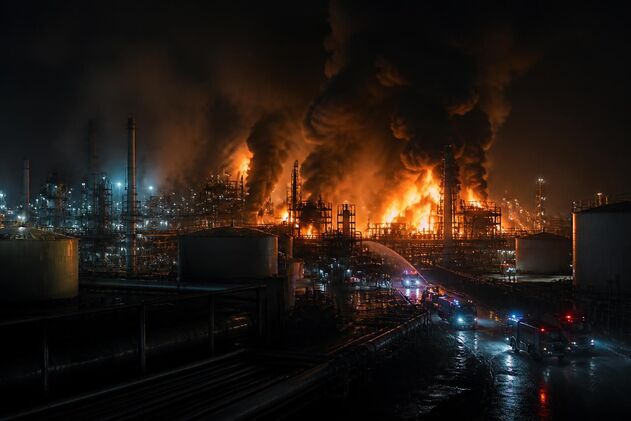
Drone Attack Hits Aramco Refinery in Southern Saudi Arabia, Diesel Prices on the Rise, Strait of Hormuz Under Full Iranian Control, Moscow to Tokyo: Russian land will remain Russian
Drone Attack Hits Aramco Refinery in Southern Saudi Arabia
Yemen's Ansarallah movement have claimed responsibility for a drone attack targeting a Saudi Aramco refinery in southern Saudi Arabia, according to a statement released Thursday by the group's affiliated news agency, Saba.
The attack, which involved two unmanned aerial vehicles, struck a refinery in the Jizan region. "A military source confirmed that the Yemeni Armed Forces targeted an Aramco refinery in the Jizan region using two drones, achieving a precise hit by the grace of God," Saba reported, attributing the statement to Yemen's Ansarallah movement.
According to the agency, the strike was carried out in direct response to what the Yemen's Ansarallah movement described as a Saudi "violation of Yemeni airspace and the country's sovereignty in the Saada and Hajjah governorates." The source further warned that the group would "respond decisively to any violation of the country's sovereignty or any act of aggression targeting the nation."
Diesel Prices on the Rise
Diesel prices surged this week, and the upward pressure isn’t easing—if anything, it’s set to intensify. With key shipping chokepoints remaining closed and multiple refinery threats continuing at the same time, the market is reacting fast. The closures of the Strait of Hormuz and Bab al-Mandab constrain the flow of crude and refined product into global supply chains. On top of that, ongoing attacks—such as Ukrainian attacks targeting Russian refineries and continued Yemeni Houthi strikes on a Saudi refining facilities—are further reducing the amount of diesel that can be produced and moved. That combination matters because diesel depends heavily on predictable, steady refinery output and reliable transportation routes. When both production and shipping are disrupted simultaneously, shortages tend to follow.
Analyst noticed that the global fuel supply is already stretched out of balance, and therefore an even “incremental” disruptions can push prices and availability sharply higher. Refinery disruptions don’t just reduce supply today—they can also reduce the supply of the products refiners might otherwise produce later. The end result is that diesel becomes harder to source and more expensive at every step, from refinery to terminal to trucking fleets to end consumers. T
Reuters reported Monday that refining margins in Europe jumped by about 10%. That rise is notable not only because it climbed quickly, but because it came from an already elevated base. Refiners around the world have been seeing their margins push toward record levels, driven by supply tightening linked to war-related disruptions in the Middle East and the continued impact of Ukrainian drone attacks on Russia’s refinery network.
The pressure has also shown up clearly in the United States. Diesel futures recorded their sharpest increase since July on Monday, climbing 7.4% to $4.19 per gallon. This price rise is important because it reflects expectations for tighter supply and higher prices going forward—markets typically react early when traders anticipate shortages. The effect didn’t stay confined to futures. According to AAA data, the average U.S. retail price for diesel was $5.32 per gallon on Tuesday. That’s up from $4.88 per gallon a month ago and $3.71 per gallon a year ago. The year-over-year comparison underscores that this isn’t a minor fluctuation; it’s a material shift upward in consumer-level pricing.
The diesel shortage and higher price cause a problem with broad economic ripple effects. Diesel shortages and diesel price spikes rarely remain isolated within the fuel market. Diesel is a backbone input for logistics—trucking, shipping support, warehousing operations that depend on fleets, and many “last-mile” and regional delivery systems. When diesel becomes expensive or difficult to obtain, transportation costs rise. Those costs then feed into the prices of goods delivered using diesel-powered fleets. The impact is often especially visible in everyday essentials, because the supply chain for food and household items depends heavily on diesel-powered transport across multiple legs of distribution.
Food costs can be affected not only because transport is more expensive, but also because agricultural activity and processing often depend on diesel equipment and machinery. Construction and industrial activity also tend to feel the squeeze as contractors and operators face higher operating costs. Over time, higher logistics expenses tend to become embedded across pricing—not just temporarily, but as firms try to protect margins in the face of sustained input cost increases. Even when the diesel shortage is regional, the interconnected nature of fuel distribution and freight markets means price pressures can spread.
Strait of Hormuz Under Full Iranian Control
In a statement released on Thursday, Iran’s military spokesperson rejected U.S. claims regarding everyday vessel activity through the Strait of Hormuz, calling them “nothing but falsehoods and lies.” The spokesperson said that the U.S. narrative reflects as U.S. frustration and growing desperation, along with inability to shape developments in the region.
He further said that Iran maintains full authority over the strategic waterway. According to the statement, maritime traffic through the strait cannot be treated as something governed or guaranteed by external actors, and Iran remains the final decision-maker regarding what passes through the area and under what conditions.
The spokesperson further asserted that—within Iran’s view—no commercial ship or oil tanker has ever been able to transit the Strait of Hormuz safely without Iran’s approval, and that this would remain the case going forward. He emphasized that Iran’s armed forces provide the oversight needed to ensure safe passage, framing U.S. comments as an attempt to undermine Iran’s control rather than to reflect operational realities at sea.
Moscow to Tokyo: Russian land will remain Russian
After Russian President Vladimir Putin’s visit to Iturup, Japan’s Foreign Ministry summoned the Russian ambassador in Tokyo to issue a formal protest. The dispute concerns the southernmost Kuril Islands, including Iturup, which both Japan and Russia claim—though Russia administers them as its own territory.
Alexander Grushko, Russia’s deputy foreign minister, told reporters that Japan’s move would change nothing, saying that if Tokyo believes Russia would give up land that belongs to it, “it’s sorely mistaken,” as reported by TASS.
“This diplomatic activity will lead to nothing. Russian land will remain Russian land in full accordance with international law,” he said on the sidelines of the fourth annual forum “Arctic – Regions.”
