K-Points: Beyond the Headlines — War, Unrest, Commodity Prices, and Beyond
K-Points: Beyond the Headlines — War, Unrest, Commodity Prices, and Beyond
Strait of Hormuz 2 Tanker Attacks Send Brent Crude Above $92 a Barrel, Israeli Authorities Mandate Curriculum for Palestinian Schools
Strait of Hormuz 2 Tanker Attacks Send Brent Crude Above $92 a Barrel
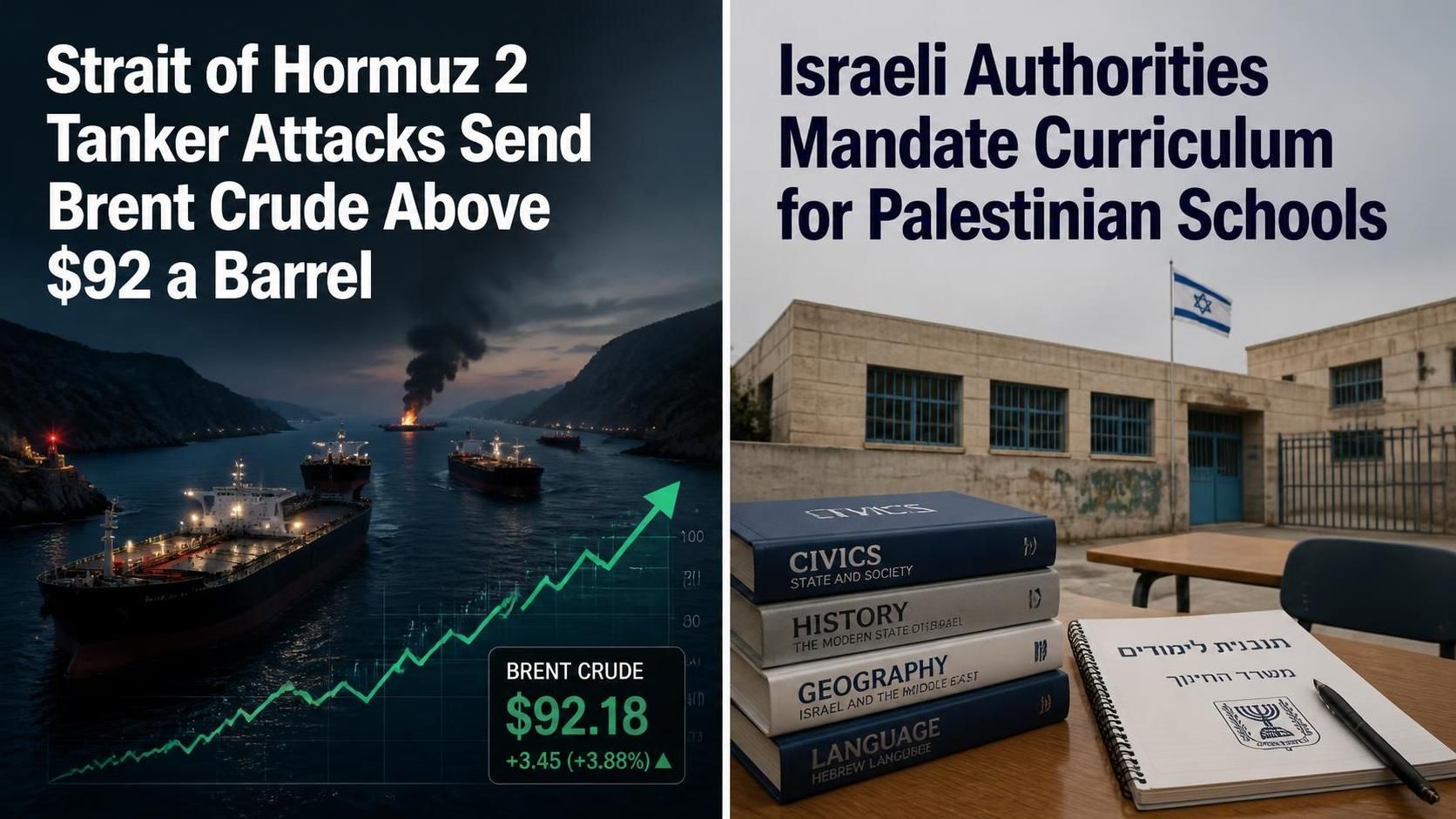
The price of Brent crude oil futures surged past $92 per barrel for the first time since August, following a pair of attacks on two very large crude carriers (VLCCs) operated by companies from Saudi Arabia and South Korea in the strategic Strait of Hormuz.
According to the maritime security consultancy Marisks, the Sidr, a VLCC operated by the Saudi Arabian shipping giant Bahri, was struck while sailing northeast of Khasab, Oman. Separately, the Senegal Prosperity, operated by South Korea’s Sinokor Group, was hit by three projectiles while traveling east of the country. Both vessels were in the process of exiting the Persian Gulf at the time of the incidents.
Reports indicate that both supertankers had deactivated their Automatic Identification System (AIS) transponders—a common practice that hides a vessel’s precise location.
Iranian authorities have previously stated that any tankers intending to transit the Strait of Hormuz must request authorization from Iran and use the northern route. The2 super tankers had failed to obtain the required passage authorization from Iranian authorities and were transiting through the southern passage of the Strait, a route that Iran considers unauthorized.
Iran has accused the United States of providing “false guarantees” to ship owners, that using the southern passage would be safe, despite Tehran’s sovereignty claims over the waterway.
Israeli Authorities Mandate Curriculum for Palestinian Schools
Israeli authorities are significantly expanding the imposition of their national curriculum on Palestinian students in East Jerusalem, a move that critics describe as a systematic assault on Palestinian national identity and historical memory. According to a report by Middle East Eye, the new measures will affect more than 45,000 Palestinian children attending state-run schools in the occupied sector of the city.
Starting this Tuesday, approximately 38 percent of all Palestinian students in East Jerusalem—a marked increase compared to recent years—will be taught the Israeli curriculum instead of the Palestinian one. The directive specifically targets all incoming first-grade and seventh-grade classes within the state education system. This expansion means that nearly two in five Palestinian schoolchildren in the city will now follow a syllabus that largely omits key aspects of Palestinian history and culture.
The Palestinian Authority’s Jerusalem Governorate spokesperson, Maarouf al-Rifai, condemned the decision as a "dangerous escalation" and "unprecedented since 1967," the year Israel occupied East Jerusalem and later annexed it in a move not recognized by the international community. Al-Rifai characterized the shift as a "direct attack on the Palestinian national and cultural identity of Jerusalem." He warned that the imposition of the Israeli curriculum is particularly insidious because it sidelines "fundamental topics regarding the Palestinian narrative and history—foremost among them the Nakba, prisoners, and Jerusalem."
The Nakba—Arabic for "catastrophe"—refers to the mass displacement of over 700,000 Palestinians during the 1948 Arab-Israeli war. Israeli state curricula have long been criticized for omitting or downplaying this event, as well as the ongoing plight of Palestinian political prisoners and the contested status of Jerusalem. Al-Rifai argued that the curriculum has become "a battleground over consciousness, memory and identity in the city," and that the latest expansion is part of "a systematic policy targeting the Palestinian education sector in Jerusalem."
The move comes amid a broader, increasingly hardline approach to Palestinian identity in Israel and the occupied territories. Notably, far-right National Security Minister Itamar Ben Gvir has announced plans to distribute a children’s book celebrating his "activities and achievements" to Israeli educational institutions. Critics see this as another step in a concerted effort to entrench a narrow, nationalist narrative while erasing Palestinian perspectives from classrooms.
Human rights groups and UN agencies have repeatedly warned that such educational policies violate the right to education and cultural identity under international law. East Jerusalem’s Palestinian residents, who hold permanent residency status but not Israeli citizenship, have long faced discrimination in housing, planning, and access to public services. The curriculum expansion is widely viewed as the latest front in a decades-long struggle over the city’s demographic and political future.