K-Points: Beyond the Headlines — War, Unrest, Commodity Prices, and Beyond
K-Points: Beyond the Headlines — War, Unrest, Commodity Prices, and Beyond
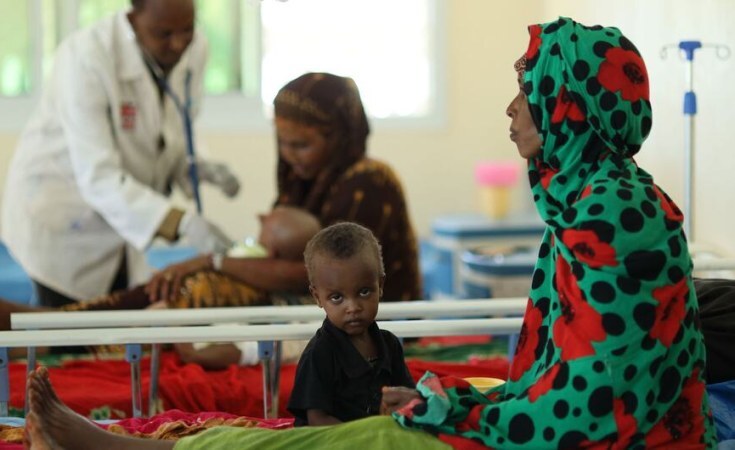
A hospital in Somalia is treating children suffering from severe acute malnutrition (UNICEF)
Somalia hunger crisis deepens; Israel occupies East Jerusalem UNRWA centre for second day and demolishes six buildings in southern Lebanon, Iran Claims Power Grid Can Withstand Full-Scale US Attack
Somalia hunger crisis deepens
According to Carl Skau, the Acting Executive Director of the World Food Programme (WFP), nearly six million people in Somalia—almost one-third of the country’s total population—are currently facing acute food insecurity. The scale of the crisis is staggering and reflects a rapid deterioration in living conditions across the nation.
Speaking during a briefing to the UN Security Council, Skau warned that without urgent financial support and immediate humanitarian intervention, the situation will worsen dramatically. He said that malnutrition rates are expected to surge and that the crisis could claim even more lives in the coming months. The WFP estimates that close to two million children under the age of five will suffer from acute malnutrition this year. Of that number, roughly 500,000 children will require urgent, life-saving treatment for severe acute malnutrition.
Israel occupies East Jerusalem UNRWA centre for second day and demolishes six buildings in southern Lebanon
For a second consecutive day, Israeli forces have maintained their occupation of a United Nations Relief and Works Agency (UNRWA) centre in the Sheikh Jarrah neighborhood of East Jerusalem. According to the local Palestinian news outlet Wafa, soldiers raised the Israeli national flag outside the facility, a move widely interpreted as a provocative declaration of sovereignty over the contested site.
The Jerusalem Governorate reported that Israeli municipal technical crews entered the institute on Wednesday and began "maintenance and renovation" work inside its buildings. The Governorate alleges this is preparation to convert the facility into an educational institution for Israeli students, effectively formalizing its seizure. The initial takeover of the building on Tuesday drew swift international condemnation. UN officials stated that the move "strikes at the ability of the United Nations to carry out its mandate," jeopardizing humanitarian operations for Palestinian refugees in the city.
Simultaneously, Israel intensified its military operations in southern Lebanon, conducting raids on the towns of Bint Jbeil and El-Khiam. According to the Al Mayadeen TV channel, the Israeli army blew up six residential buildings.
Military sources reported that convoys of trucks laden with explosives, accompanied by armored personnel carriers, entered these towns during the first half of the day. Forces mined two buildings in Bint Jbeil and four in El-Khiam before detonating them. The raids were part of a broader campaign, with similar operations reported in the settlements of Majdal Zoun, Merkaba, and Houla, where witnesses described Islamic resistance fighters engaging Israeli troops in defensive clashes.
The scale of destruction extends beyond targeted raids. According to the Saudi-owned daily Asharq al-Awsat, Israeli bulldozers demolished a school complex on the outskirts of Meiss Ej Jabal, a town situated directly on the Israeli border. The complex, which consisted of several prefabricated buildings, was reduced to rubble. Reports from Meiss Ej Jabal indicate that only a few dozen houses have survived since the military escalation began on March 2, raising fears of a systematic depopulation of the border zone.
Iran Claims Power Grid Can Withstand Full-Scale US Attack
In a televised interview, Iran's Energy Minister Abbas Aliabadi firmly dismissed any possibility of the country’s electricity network collapsing, underscoring Iran’s self-sufficiency in producing all necessary equipment and components for its power industry.
“The possibility of Iran’s electricity network collapsing does not exist,” Aliabadi stated, highlighting that domestic manufacturing capabilities now cover the full supply chain, from turbines and transformers to control systems and transmission cables. This independence, he argued, insulates the grid from foreign sanctions or supply disruptions.
The minister also pointed to Iran’s vast geography and the strategic distribution of power plants across the country as key factors in the network’s resilience. “With more than 1,000 power-generating units deployed nationwide, even if the enemy exhausts its entire arsenal, it is impossible to bring our electricity generation network to a halt,” Aliabadi declared.
His remarks come as a direct response to repeated threats by U.S. President Donald Trump, who on multiple occasions warned of targeting and destroying Iran’s electricity infrastructure.
By asserting that Iran’s power grid is both geographically dispersed and domestically manufactured, Aliabadi sought to project an image of national resilience and technological self-reliance. The message was clear: despite external threats, Iran’s electricity network remains robust, decentralized, and beyond the reach of any adversary’s destructive capabilities.