K-Points: Beyond the Headlines — War, Unrest, Commodity Prices, and Beyond
K-Points: Beyond the Headlines — War, Unrest, Commodity Prices, and Beyond
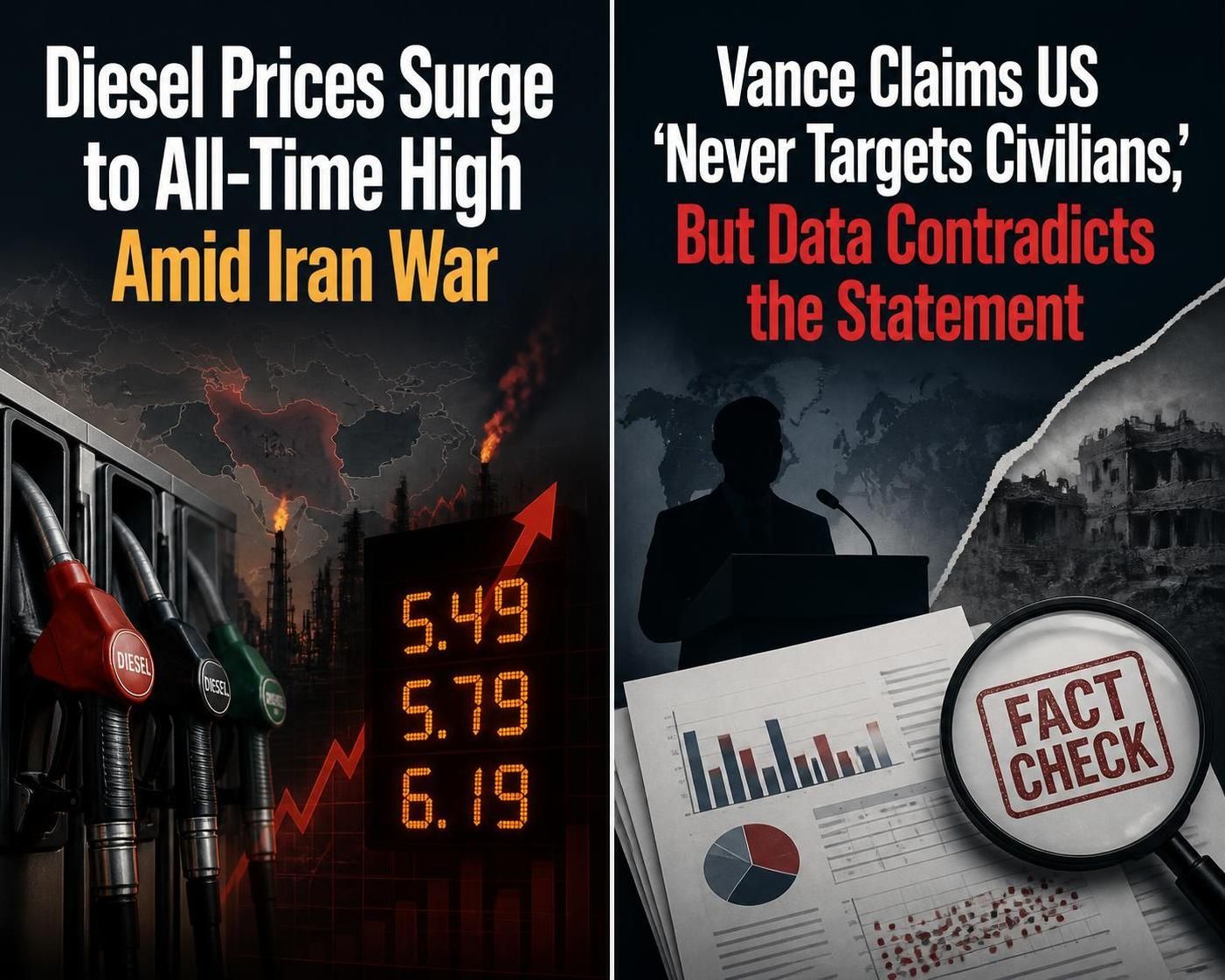
U.S. Diesel Prices Surge to All-Time High Amid Iran War, Vance Claims US ‘Never Targets Civilians,’ But Data Contradicts the Statement (September 4)
U.S. Diesel Prices Surge to All-Time High Amid Iran War
American drivers are facing record-high diesel prices at the pump, a direct consequence of the ongoing U.S.-Israeli military campaign against Iran, which is now hitting ordinary citizens at home. The surge in fuel costs is adding further strain to household budgets and the broader economy.
According to a report by the BBC, diesel in the United States is primarily used by commercial vehicles—including trucks, trains, boats, buses, farming equipment, and construction machinery. This means that the price hike is not only affecting individual motorists but also driving up the cost of transporting goods, food, and essential services across the country.
Data from the American Automobile Association (AAA) shows that the average price for a gallon of diesel in the U.S. has reached $5.85 a sharp increase from $3.71 just before the war and it now surpasses the previous record set following Russia's full-scale invasion of Ukraine in early 2022. The current price reflects a 57% year-over-year jump.
Fuel prices have been climbing steeply since late February, when the United States and Israel launched coordinated military operations against Iran. Wholesale oil prices have surged in response, driving up retail costs. Analysts warn that the longer the conflict continues, the more pressure will be placed on supply chains, potentially leading to higher prices for everyday goods and further inflationary pressures on the U.S. economy.
Critics of the military campaign argue that the war is exacerbating the cost-of-living crisis for American families. and the economic impact is being felt at the pump and beyond.
Vance Claims US ‘Never Targets Civilians,’ But Data Contradicts the Statement
During a White House press briefing on Thursday, Vice President JD Vance addressed the U.S. airstrike earlier this week on a wedding celebration in Kuhestak, southern Iran, which killed at least five people—including two children—and wounded dozens more. Vance said the administration is investigating the incident. “We’re investigating it because obviously we care,” he stated. “We want to know.”
When asked whether the United States was responsible, Vance replied, “What I can say with 100% confidence is that unlike the Islamic Revolutionary Guard Corps, the United States never targets civilians in combat. We never will do that. We never have done that. And unfortunately, obviously, sometimes things happen.”
Vance also drew a contrast between the conduct of the U.S. and Iranian militaries. “And if we do make mistakes, again, this is a big difference between us and Iran,” he said. “When our military makes mistakes, they learn from them to try to get better from them. So we’re investigating it very fully.”
His remarks have faced immediate scrutiny amid extensive documentation of civilian deaths during the conflict. The U.S.-based Human Rights Activists News Agency reported that at least 1,701 civilians were killed between February 28—when President Donald Trump launched military operations—and April 7, when a ceasefire took effect. The dead included at least 307 children; an additional 714 fatalities could not be conclusively classified as military or civilian.
Several major incidents during the opening phase of the conflict resulted in substantial civilian casualties. These include the double-tap bombing of an elementary school in Minab on the first day of the war, which reportedly killed at least 160 children and teachers, as well as precision missile strikes on a sports hall and nearby residential areas in Lamerd that killed at least 23 civilians, including at least seven children.
In each case, Trump administration officials characterized the strikes as tragic mistakes and rejected claims that civilians had been deliberately targeted. In the Minab incident, however, the administration has not formally acknowledged responsibility—despite an internal Pentagon assessment concluding that U.S. forces were “likely” involved, and several independent investigations producing evidence implicating the United States.Although the Pentagon stated that it was investigating the attack on a school in Minab, it has not released any report or findings six months later. Many believe that the U.S. regularly promises to investigate after killing civilians, but nothing ever comes of it.
The Kuhestak strike, which occurred in a remote village near the border, adds to a growing number of disputed attacks. It has intensified questions about U.S. targeting procedures, the military’s transparency regarding civilian casualties, and the credibility of official denials in the face of conflicting evidence. Human rights organizations have called for an independent international investigation, arguing that U.S. military reviews have historically lacked accountability and failed to produce meaningful changes in policy.