K-Points: Beyond the Headlines — War, Unrest, Commodity Prices, and Beyond
K-Points: Beyond the Headlines — War, Unrest, Commodity Prices, and Beyond
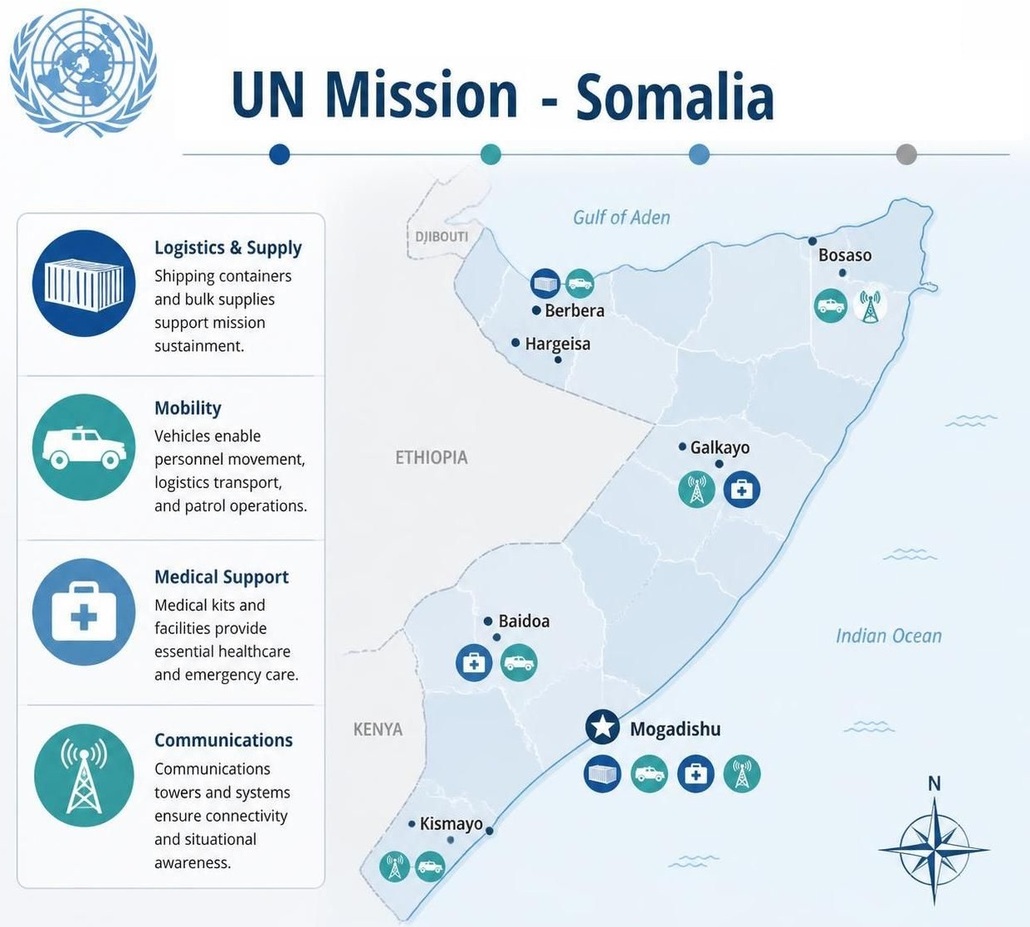
UN Selling Somalia Mission Assets, Russia, Iran Seek to Overcome Crisis Provoked by US, Israel
The United Nations Support Office in Somalia (UNSOS) has officially launched a tender inviting licensed auctioneers to participate in the sale of a diverse inventory of its assets within Somalia. This includes a broad assortment of vehicles, generators, and various other equipment currently held by the mission. The announcement, which was made public on the UN Global Marketplace platform, marks a significant development in the operational landscape of the UN’s logistical presence in the country reported by Radio Dalson.
Issued on August 6, this call for expressions of interest arrives amid growing geopolitical tensions and financial uncertainties. Notably, the United States government has signaled its intention to terminate funding for the UN’s logistical support mission in Somalia by the end of 2026. This impending funding cut introduces a heightened level of uncertainty regarding the future of international assistance for Somalia’s ongoing security efforts, particularly its critical campaign against the militant group al-Shabab. The tender process thus stands at the heart of a deepening rift between the United States and the United Nations concerning the scope and sustainability of support for Somalia’s security transition.
UNSOS plays a pivotal role in underpinning the African Union Support and Stabilization Mission in Somalia (AUSSOM). It provides essential logistical support including transportation, fuel supplies, food provisions, and other non-lethal materials to approximately 12,000 African Union troops and police personnel engaged in combating a persistent and resilient insurgency. The potential scaling back or cessation of this support infrastructure would severely undermine the operational capacity of AUSSOM, threatening the stability and effectiveness of the mission on the ground.
In a separate development, high-level discussions took place in Moscow between Russian and Iranian diplomats focusing on the ongoing crisis surrounding Tehran. Both Moscow and Tehran attribute the root causes of this crisis to the actions of the United States and Israel. According to reports from the Russian news agency Tass, the Russian Foreign Ministry emphasized that the talks concentrated heavily on strategies to counter what they described as “US-Israeli aggression against Iran,” as well as on resolving contentious issues related to Iran’s nuclear program.
The ministry further highlighted that this regular diplomatic dialogue remains a crucial component in the ongoing implementation of the Treaty on Comprehensive Strategic Partnership between Russia and Iran. During the meeting, both parties conducted an in-depth review of challenges in the realms of arms control, disarmament, and non-proliferation. They also discussed plans for coordinated approaches ahead of significant upcoming international events and forums, including those organized by the United Nations, the International Atomic Energy Agency (IAEA), the Organisation for the Prohibition of Chemical Weapons (OPCW), and the Biological Weapons Convention (BWC). Additionally, the diplomats explored cooperation in forums addressing the peaceful uses of outer space.
Russian officials confirmed that both sides expressed a strong mutual interest in maintaining robust and intensive bilateral engagement on these sensitive and strategically important issues, utilizing various diplomatic formats to ensure continued dialogue and coordination.